



Choose Proxies for Price Monitoring by Location and Type

David

The right proxy for price monitoring depends on the shopper’s apparent location, the marketplace you’re checking, and how the site responds to repeated requests. Price monitoring means collecting and comparing product prices across retailers, marketplaces, and locations. Proxies for price monitoring route requests through different IP addresses, helping you capture location-specific results and distribute collection activity. They do not grant permission to collect data.
It’s easy to focus on proxy type alone, but location and marketplace matter just as much. Residential proxies may suit some retailers’ product pages, while mobile proxies can be a better fit for app-based checks. The target country or city can also affect the prices and offers you see.
This guide explains how price monitoring works and how to choose among residential, datacenter, mobile, ISP, and other proxy options. You’ll learn how to match location targeting and session behavior to your marketplaces, assess compatibility, and account for compliance when planning your monitoring workflow.
Key Takeaways
- Match rotating or sticky sessions to the task: use rotation to spread requests and sticky sessions when a sequence of checks needs the same IP.
- Choose geographic targeting based on the shopper view you need, from country-level comparisons to city-specific results.
- Compare residential and datacenter proxies against each marketplace’s access patterns, then consider mobile proxies for app-focused price checks.
- Build a monitoring workflow around public pricing data, reasonable request rates, and the terms that apply to each marketplace.
- For mobile-focused monitoring needs, dedicated 4G and 5G mobile proxies are options to consider alongside the target location and collection setup.
What is price monitoring?
Price monitoring collects product prices from retailer pages or marketplaces, then compares them across time and locations. For example, a retailer can repeatedly check the same product page to see whether a competitor changes its offer. Proxies for price monitoring route requests through different IP addresses. They help vary the apparent connection, but do not grant permission to collect data.
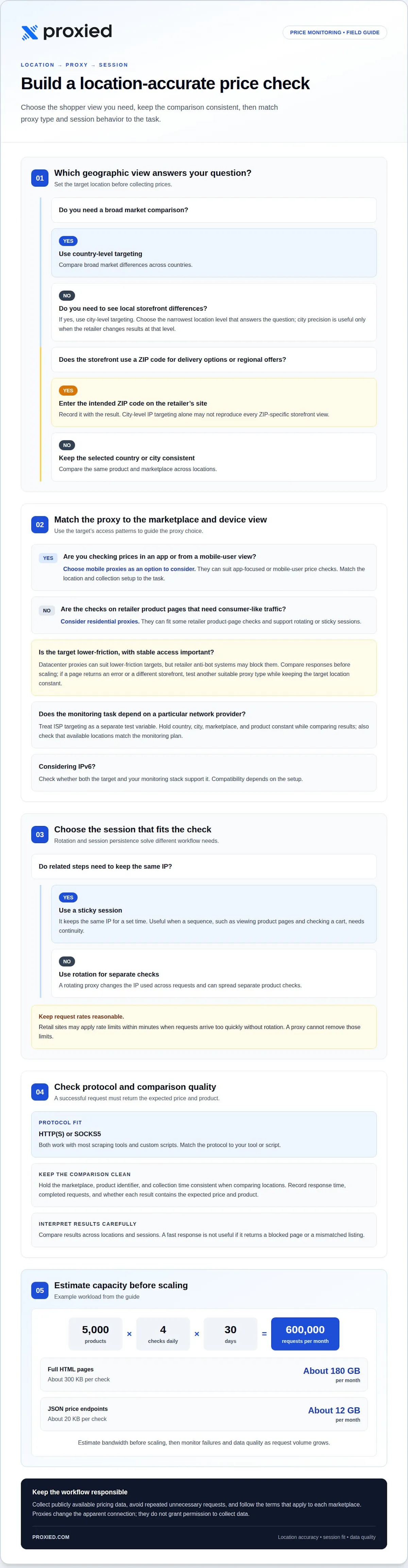
Rotation and session persistence serve different purposes. A rotating proxy changes the IP used across requests, while a sticky session keeps the same IP for a set time. Use rotation for separate product checks; choose a sticky session when related steps, such as viewing product pages and checking a cart, need continuity.
Protocol support affects how a proxy connects to your monitoring script. HTTP(S) and SOCKS5 work with most scraping tools and custom scripts. Retail sites may apply rate limits within minutes when requests arrive too quickly without rotation. A proxy can't remove those limits, so pace requests and match the session style to each task.
How do you assess a proxy provider’s reliability, pricing, and geographic coverage? Compare billing terms, measured uptime, and the countries or cities available for your target markets. Then test a representative monitoring task and assess completed requests and location accuracy.
What do proxy services for price monitoring cost in the United States? Pricing depends on proxy type, bandwidth use, and workload. Residential and mobile proxies are commonly charged by bandwidth, while ISP and datacenter options are commonly charged by IP.
How can you reduce proxy blocks, CAPTCHAs, and failed requests? Keep request rates reasonable, use rotation for separate checks, and use sticky sessions for multi-step tasks. Collect publicly available pricing data and avoid sending repeated, unnecessary requests to the same page.
How should you measure proxy speed, success rate, and data quality? Record response time, completed requests, and whether each result contains the expected price and product. Compare results across locations and sessions. A fast response is not useful if it returns a blocked page or a mismatched listing.
Option | Session fit | Practical consideration |
|---|---|---|
Residential | Rotating or sticky | Useful when checks need consumer-like traffic. |
Datacenter | Rotating or sticky | Retailer anti-bot systems may block these IPs. |
IPv6 | Depends on setup | Check whether the target and monitoring stack support it. |
ISP | Depends on setup | Compare its fit with target access and billing needs. |
Mobile | Rotating or sticky | Useful for app or mobile-user price checks. |
HTTP(S) or SOCKS5 | Protocol choice | Match the protocol to your tool or script. |
Choose a proxy by matching its type, session behavior, and protocol to the retailer and workflow, rather than selecting by IP count alone.
Size capacity from request volume and response size. A workload checking 5,000 products four times daily for 30 days makes 600,000 requests per month. Downloading full HTML pages at about 300 KB per check uses about 180 GB per month; JSON price endpoints at about 20 KB per check use about 12 GB per month. Estimate bandwidth before scaling, then monitor failures and data quality as request volume grows.
Country, city, ISP, and other geographic targeting
A product’s displayed price can vary by location, so a national average may hide meaningful differences. Flights, hotel rates, SaaS subscriptions, and consumer products can all show location-based pricing. Set the target location before collecting data, then compare the same product and marketplace across locations. This separates location effects from ordinary product or seller changes.
Residential and datacenter IPs can be targeted by country, state, and city. Choose the narrowest level that answers your question. Country targeting can reveal broad market differences, while city targeting can show local storefront variations. More precise targeting is useful only when the retailer changes its results at that level.
For example, compare a product listing in New York and Los Angeles before expanding to other US cities. Keep the marketplace, product identifier, and collection time consistent. If prices differ, repeat the checks to see whether location remains the likely cause. This produces a cleaner comparison than changing both location and product.
ZIP codes require care. A storefront may use a ZIP code to calculate local delivery options or present a regional offer, but that is separate from the proxy IP’s location. Enter the intended ZIP code in the retailer’s own location field and record it with the result. City-level IP targeting alone may not reproduce every ZIP-specific storefront view.
Datacenter proxies can suit lower-friction targets where access is stable and collection needs to be consistent. Retailer anti-bot systems may block datacenter IPs, so compare responses before scaling. If a location-specific page returns an error or a different storefront, test another suitable proxy type while keeping the target location constant.
ISP targeting can help distinguish network contexts when the monitoring task depends on a particular provider. Treat it as a separate test variable: hold the country, city, marketplace, and product constant while comparing results. Check that selected countries and cities match your monitoring plan, since no location setting provides unlimited coverage by default.
What alternatives to proxies are available for collecting retail pricing data? Retailer APIs, approved data feeds, and manual checks can provide pricing information. Availability and geographic detail vary, so compare each method with the locations and marketplaces you need to monitor.
Use this sequence to structure a geo-targeted check:
- Select the country and, where useful, state or city.
- Set the retailer’s ZIP code separately when the storefront uses one.
- Keep the product, marketplace, and collection conditions consistent.
- Record the location beside each price for later comparison.
Choose the targeting level that answers your business question, then expand only if local results differ.
Choosing between residential and datacenter proxies
Residential proxies can be a strong starting point for retail price checks because they use consumer internet connections. Datacenter proxies may work for lower-friction targets, but retailer anti-bot systems may block them. The right choice depends on how the marketplace responds to your collection workflow, not on a universal ranking.
What types of proxies are best for price monitoring? Use residential proxies when a retailer requires a consumer-like connection, and datacenter proxies when the target accepts them reliably. Mobile proxies can suit app-focused checks, while ISP proxies are another option to test against the retailer’s access patterns.
For a difficult retail target, test residential IPs against a small set of product pages first. Record whether each response contains the expected listing and price, rather than counting successful connections alone. A block screen, CAPTCHA, or incomplete page may mean the connection is unsuitable for that task. Keep request rates reasonable and collect public pricing data.
Residential proxies can also support geographic comparisons when a retailer displays different storefronts by location. Keep the product, marketplace, and collection time consistent while testing locations. This helps distinguish a location-based price difference from changes caused by availability or seller selection.
Datacenter proxies may suit broad, predictable monitoring when pages load consistently through those addresses. They are best suited to targets that accept the connection and return complete product data. If results become blocked or inconsistent, compare another proxy type instead of increasing request volume. More requests will not fix a poor connection fit.
Websites can detect and block proxy traffic using signals such as IP reputation, request patterns, and repeated access. A burst of similar requests or repeated visits to the same product path may trigger limits or CAPTCHAs. Reduce unnecessary requests, vary collection timing sensibly, and check returned pages for block messages.
Compare the options against your target and monitoring method:
Proxy type | Useful for | Trade-off to assess |
|---|---|---|
Residential | Retail pages needing consumer-like traffic | Check returned content and bandwidth use. |
Datacenter | Stable, lower-friction targets | Retailer anti-bot systems may block access. |
Mobile | Apps or sites focused on mobile users | Use when the mobile view is the target. |
ISP | Comparative testing against retail access patterns | Assess results on the specific marketplace. |
Run a controlled test before expanding collection. Check the same product pages through each suitable option, then compare successful responses, complete price fields, and block pages. Choose the proxy type that returns usable retail data with reasonable request patterns, and use a different type where marketplace behavior calls for it.
Monitoring competitor prices and seller compliance
Competitor tracking turns repeated marketplace observations into pricing intelligence. A sound process compares equivalent listings while focusing collection on public pricing data.
Competitor Price Analysis Across Markets
Market analysis compares the same product’s listed price across locations, marketplaces, and collection times. Keep the product identifier and seller type consistent, then record the price, stock status, and timestamp together. This separates genuine market differences from changes caused by a different listing or an unavailable item.
Price changes can be frequent: e-commerce pricing may change several times a day, especially during peak sale periods. Online retailers also make thousands of price changes daily. Set tracking intervals to capture relevant movement without sending unnecessary requests. For example, a sale-period review may need a different schedule from routine competitor monitoring.
Use a consistent comparison set. Match product variants, shipping conditions, and seller status wherever the marketplace displays them. If a listing is out of stock, record that separately instead of treating its displayed price as a current offer. This makes for a more useful competitor comparison than a price-only record.
Market-level analysis looks for patterns across locations and sellers, rather than focusing on a single competitor alert. A competitor may lower a product’s price in one market while maintaining it elsewhere. Group results by marketplace and location to see where the change applies, then decide whether it merits a pricing response.
E-commerce Competitor Comparisons
E-commerce comparisons focus on named competitors and equivalent products, rather than broad market movement. The reported figure that 92% of retailers use dynamic pricing illustrates why a single snapshot can miss the pattern. Amazon changes prices an average of 2.5 million times per day, while Walmart and Best Buy adjust prices up to 50,000 times per month.
Build a comparison record around the competitor, product, marketplace, location, price, and stock status. Set alerts for changes that matter to your business, such as a listing becoming unavailable or a price moving below your current offer. Alerts should follow a clear decision rule, not every minor listing update.
Proxy type and network behavior affect collection consistency, but neither replaces careful comparison. Keep request rates reasonable and collect publicly available pricing data. A proxy routes network traffic; it does not grant permission to collect data. Target-site terms and your intended use of collected information also shape compliance considerations.
For seller compliance, limit tracking to public pricing details and avoid collecting unrelated account or customer information. Review the marketplace terms that apply to your collection and use. Record the source marketplace and retrieval time so you can audit why a price alert fired and which public listing supported it.
Monitoring prices across marketplaces and regions
A global price view needs more than one marketplace or proxy location. Prices for flights, hotel rates, SaaS subscriptions, and consumer products can vary by location. Compare the same item across target marketplaces and regions, and preserve the location with every result. This helps analysts separate regional differences from changes to the listing itself.
Start with a region map: list each marketplace, target country, and required level of location detail. Residential and datacenter IPs can support targeting by country, state, and city. Use country-level checks to compare broad market views, then add state or city targeting when your question concerns a local offer, such as a retailer’s storefront in a particular city.
Keep the comparison controlled. For each marketplace, hold the product identifier and seller conditions steady, then collect results from the selected regions. Record the displayed price, stock status, timestamp, marketplace, and proxy location. If a New York result differs from a Los Angeles result, repeat the same product check before treating it as a regional pattern.
Datacenter traffic can suit lower-friction targets, but retailer anti-bot systems may block datacenter proxies. Classify each response as usable product data, a changed storefront, or an error page. An error is not a zero price, and a different listing is not a valid comparison. Track response quality by region before scaling requests.
For a reliable cross-market workflow, make a region-specific record for every check:
- Marketplace and region: identify the retailer and country, state, or city.
- Product match: use the same product identifier and comparable seller conditions.
- Collected fields: capture price, stock status, timestamp, and response outcome.
- Review action: repeat incomplete or mismatched results before drawing conclusions.
This structure makes global comparisons easier to audit. It also helps identify where traffic consistently fails, rather than confusing proxy errors with genuine regional price changes. Review each marketplace separately because page design and response behavior vary. Expand coverage only when the additional region answers a specific pricing question.
Choose the proxy type and geographic level together. A country comparison may need broad coverage, while a city-level check depends on precise targeting. Test a small set of representative products, then compare returned prices and usable responses across regions. This shows whether the collection method fits the marketplace before monitoring volume grows.
Use region-focused proxy options to plan coverage for your target marketplaces and locations.
Proxied: Dedicated 4G Mobile Proxies
Proxied offers Dedicated 4G Mobile Proxies for monitoring workflows that need mobile connectivity, such as checking prices displayed to app users. Dedicated 5G Mobile Proxies are another option for mobile-focused tasks. Match the proxy type to the marketplace, target location, and collection method, then assess whether returned pages show the relevant prices and product details.
For teams running their own mobile proxy devices, the Proxied Hoster Dashboard supports hosting and scaling that setup. Choose dedicated mobile proxies for targeted checks, or the Hoster Dashboard to host your own mobile proxy devices.
Visit proxied.com to explore Proxied’s proxy options for your monitoring workflow.
Turn your monitoring plan into a focused test
Make your next step a small, measurable pilot. Select a priority marketplace and location, define the product details that matter, and decide how you’ll evaluate useful responses. This gives your team a practical basis for choosing proxies for price monitoring as coverage expands, without scaling requests before the workflow is understood.
For mobile-focused checks, Proxied offers Dedicated 4G Mobile Proxies and Dedicated 5G Mobile Proxies. Free Virtual Numbers for receiving SMS messages are also available. Choose the offering that fits the task you’ve defined, then assess how it supports your monitoring process.
Start with the market where pricing decisions matter most, and build from the results. Contact Proxied about proxy options to discuss a suitable next step for your monitoring workflow.
Frequently Asked Questions
Residential vs datacenter proxies for price monitoring: which is better?
Residential proxies can be preferable when a retailer expects consumer-like traffic; datacenter proxies can suit targets that accept them. Test both against the same product listing and compare whether each returns the actual price, stock status, and seller details. Choose based on usable results for that marketplace, not connection speed alone. For app-focused checks, dedicated mobile proxies may be more appropriate.
How many proxies and IP addresses are needed for price monitoring at scale?
There is no universal IP count. Size the setup around request volume, collection frequency, target response, and parallel tasks. Start with a representative subset of products and measure completed requests, errors, and returned data. Increase capacity only if the workload requires more concurrent collection. Separating checks by marketplace can help show which targets need more capacity.
How do I choose US city- or state-level proxies for local price monitoring?
Choose the location level that matches the storefront behavior you need to measure. Start with a state or city, then compare the same product listing across locations while keeping the marketplace consistent. If a retailer asks for a ZIP code, enter it separately in the retailer’s location selector. IP targeting alone may not reproduce ZIP-specific delivery or storefront details, so record the ZIP code used with each result.
How can I configure proxy rotation and session persistence for price monitoring?
Use rotation for independent product checks, and keep a sticky session for linked steps that need the same IP. For example, a workflow that opens a product page and checks its cart price may need session continuity. Set the session behavior in your proxy configuration, then verify that the IP remains consistent for the required steps. Check for interrupted sessions or unexpected redirects.
What are the legal and terms-of-service risks of using proxies to monitor prices?
Risks depend on the target website’s terms, your data use, and applicable rules in your jurisdiction. Using proxies to collect publicly available pricing data is a common and widely practiced business activity. We recommend consulting your legal team regarding the terms of service of specific target websites and applicable data protection regulations in your jurisdiction. A proxy routes traffic; it does not grant permission to collect data.
Which proxy providers offer reliable pricing, uptime, and geographic coverage?
Provider reliability varies, so compare billing terms, measured uptime, and the countries or cities available for your target markets. Test a representative monitoring task and assess completed requests and location accuracy.