



Getting started with web scraping legally: data, access, and rights

David

Publicly visible data isn’t automatically free to use without limits. The University of Chicago Data Science Clinic says scraping public website data is not illegal in itself, but that does not determine whether a particular scrape is lawful. Getting started with web scraping legally means assessing what you collect, how you access it, and what you plan to do with it.
Look beyond whether a page loads without a login. Copyright, personal data, website terms, access restrictions, and the effect of automated requests can all matter, and rules vary by jurisdiction. This guide explains how those factors shape legal risk, what to consider before collecting data, and how to review your scraping plans. You’ll have a clearer basis for deciding what to collect, how to handle it, and when to seek legal advice.
Key Takeaways
- Review a site's terms and access rules before collecting data; public access alone doesn't resolve every legal risk.
- Separate factual information from protected creative content, and consider how your intended use may affect copyright concerns.
- Plan scraper behavior to respect access limits and avoid placing unnecessary load on the site.
- Assess whether collected information identifies people, then consider which privacy rules may apply to your collection and use.
- Build a legal review around the target site, the data, the collection method, and your intended use before scaling a scraping project.
Is Web Scraping Legal Or Illegal?
Web scraping is not automatically illegal just because data appears online. The University of Chicago Data Science Clinic says scraping publicly available website data is not illegal in itself, but terms, access methods, and intended use still matter.
Terms of Service and Scraping
Terms of service set conditions for accessing and using a website’s content. They may restrict automated collection, copying, or reuse, even when pages are public. The University of Chicago Data Science Clinic advises following the data provider’s applicable terms. Read them before building a collector, and look for rules on bots, bulk requests, or commercial use.
Breach of Contract Risks
A breach-of-contract claim argues that a party failed to meet the terms of an agreement. Website operators have sued scrapers and purchasers of scraped data, alleging that terms limited access or later use. A public page alone does not establish whether a contract applies or was breached. That depends on the agreement, how it was presented, the user’s conduct, and the data’s subsequent use.
Clickwrap Agreements and Terms of Use
Clickwrap is an online agreement that asks a user to accept terms, often by selecting a button or checkbox. Accepting can make those terms relevant to later activity through the account. For example, accepting terms before accessing a data portal can create a different contractual context from viewing an open page. Consider account acceptance and access when assessing a scraping plan.
Robots.txt and Website Terms
A robots.txt file communicates a website’s preferences for automated crawlers, but it is distinct from contractual terms. It does not replace a terms-of-service review or settle every legal question. Still, the University of Chicago Data Science Clinic advises following applicable access guidelines, and EU scrapers should not scrape URLs disallowed by robots.txt. Treat a disallowed path as a clear signal to stop and reassess.
Terms and technical access restrictions can raise separate concerns. A site may allow page views while its terms limit automated collection, or robots.txt may identify paths crawlers should avoid. In the United States, the Ninth Circuit held that a website operator can revoke an authorized user’s permission, making later scraper access potentially unauthorized under the CFAA. Check the site’s terms, access conditions, and any changes to permission before continuing.
When getting started with web scraping legally, distinguish “publicly available” from “unrestricted.” Courts may consider the agreement and how access occurred, not just whether a page loaded in a browser. If a site blocks an account or revokes permission, switching accounts or continuing requests can raise additional issues. Pause collection when access terms conflict with your intended method, then reassess the source and scope.
Copyright and text-and-data-mining exceptions
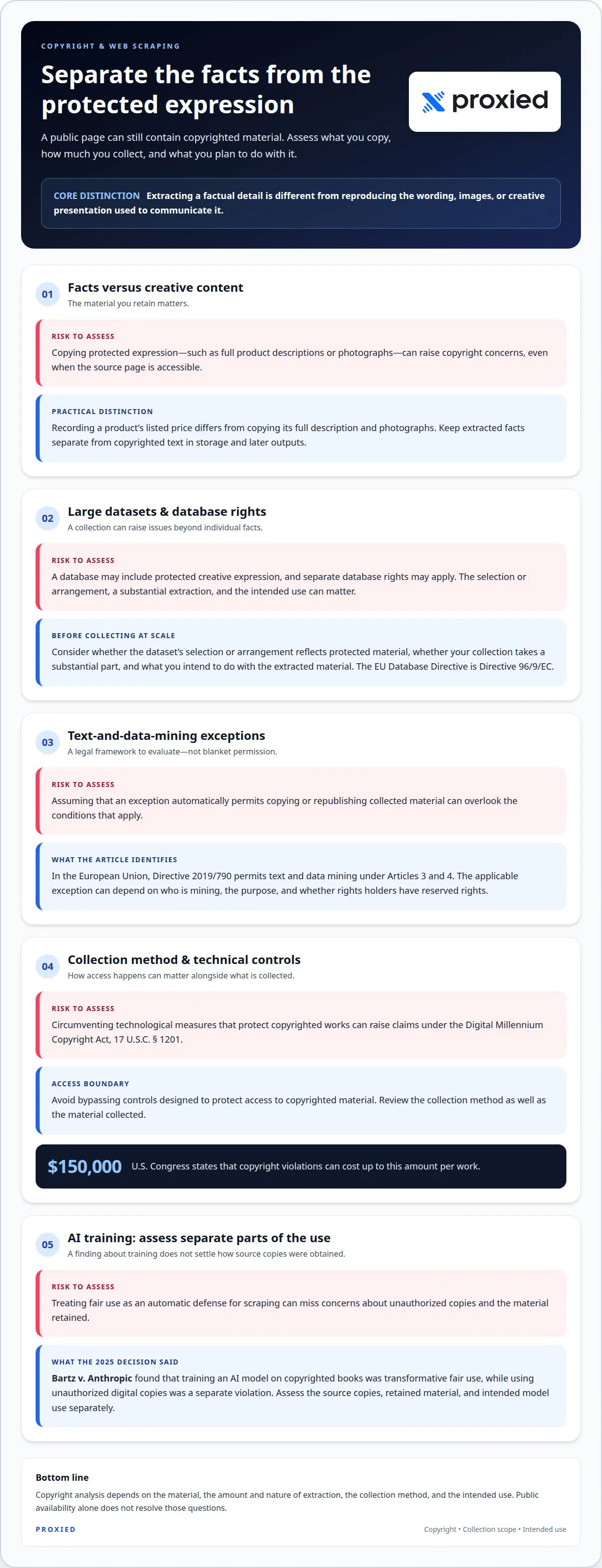
Scraping can involve copying copyright-protected material, even when the source page is accessible. A key distinction is often between extracting facts and reproducing protected expression, along with the purpose and scope of the collection.
Text-and-Data-Mining Exceptions
Text-and-data-mining exceptions allow certain automated analysis of content under specific legal conditions. In the European Union, Directive 2019/790 permits text and data mining under Articles 3 and 4. The applicable exception can depend on who is mining, the purpose, and whether rights holders have reserved rights. Treat the exception as a legal framework to assess, not blanket permission to copy or republish collected material.
Copyright Infringement and DMCA Protections
Copyright infringement can arise when scraping copies protected expression without a valid legal basis. U.S. Congress states that copyright violations can cost up to $150,000 per work. The Digital Millennium Copyright Act, 17 U.S.C. § 1201, governs claims involving circumvention of technological measures that protect copyrighted works. Avoid bypassing controls designed to protect access to copyrighted material; collection method can matter as well as the material collected.
Copyrighted Content and Database Rights
A database may contain both unprotected facts and protected creative expression, while separate database rights may also apply. The European Union’s Database Directive, Directive 96/9/EC, concerns the legal protection of databases. Before collecting a large dataset, consider whether the selection or arrangement reflects protected material and whether the collection takes a substantial part. The nature and intended use of the extraction can affect the rights analysis.
Copyright and Factual Information
Individual facts differ from the original wording, images, or creative presentation used to communicate them. For example, recording a product’s listed price is different from copying its full description and photographs. The University of Chicago Data Science Clinic advises considering whether information is factual and whether copying it could infringe copyright. Keep extracted facts separate from copyrighted text in storage and later outputs.
AI training adds another layer. In 2025, the decision in Bartz v. Anthropic found that training an AI model on copyrighted books was transformative fair use, while using unauthorized digital copies was a separate violation. Fair use is not an automatic defense for scraping. Assess the source copies, the material retained, and the model’s intended use separately; a favorable analysis of training does not erase concerns about how the source material was obtained.
Legal checks before scraping
A sound review considers the source, data, collection method, and intended use together. In the United States, legality depends on the jurisdiction and specific circumstances, not simply whether a page loads.
Pre-Scraping Legal Review
A pre-scraping legal review assesses whether a planned collection respects applicable laws and access conditions. Personal data, copyrighted material, and collection methods can each affect the risk. Start by identifying the website operator, data fields, and where the people or business records relate to. Then assess the intended use and whether another lawful access route, such as an API, is available.
For U.S. projects, consider the Computer Fraud and Abuse Act, copyright law, and relevant state privacy laws. California Penal Code § 502 is a state analogue to the CFAA. A trespass-to-chattels claim may depend on whether access was unauthorized and caused harm. That makes the method and system impact important, not just the dataset’s contents.
Next, classify each field. A company’s public address raises different concerns from a person’s profile details or biometric information. The University of Chicago Data Science Clinic advises scraping only information publicly available without a password authentication barrier. Its guidance also recommends respecting a website’s API or specific data-access rules when available, and asking the organization whether it can provide the data directly.
Legal Steps for a Basic Web Scraper
A basic scraper retrieves pages and extracts selected information; sound legal design limits what it accesses and how it behaves. A technically successful collection can still create legal exposure. Define the dataset and purpose first, then restrict requests to permitted public pages and necessary fields.
- Choose the source. Record the site, relevant terms, access instructions, and any API or data-request channel.
- Set the scope. Exclude password-protected pages and fields unrelated to the collection’s stated purpose.
- Control requests. The University of Chicago Data Science Clinic advises limiting scraping so it does not overburden the target website. Use restrained request patterns and stop if the system shows strain.
- Review the output. Separate facts from copied creative material, and assess personal information before using or sharing results.
Businesses should document these decisions before collection starts. A short record can identify the source, approved fields, access method, intended use, and conditions that trigger a pause. Revisit it if the site changes its access rules, the dataset expands, or a new use emerges. In the United States, this process links technical choices to the legal factors governing the specific project.
What are the steps to build a basic web scraper legally?
Build the collector around a defined purpose, permitted access, and limited fields. A product-catalog project, for example, might need product names and listed specifications, not every page element.
- Define the collection. Write down the project’s purpose, the source, and the exact fields required. A price-monitoring dataset might need product names, listed prices, and page dates. Exclude unrelated profiles, images, or descriptions. A narrow scope makes it easier to assess what the scraper collects and how the output will be used.
- Select an access route. Use an available API or the site’s stated data-access guidelines when they fit the task. The University of Chicago Data Science Clinic advises respecting an applicable API or specific access guidelines, and asking the organization whether it can provide the data without scraping. Avoid password-protected content and access methods that bypass barriers.
- Implement only the required extraction. Configure the scraper to request the selected pages and parse named fields, rather than copying entire pages by default. For a public catalog, that could mean extracting each item’s name and displayed category while ignoring biographies or customer comments. Keep the code’s target paths and output fields documented, so later changes do not silently broaden collection.
- Limit the system impact. The University of Chicago Data Science Clinic advises limiting scraping so it does not overburden the target website. Use a restrained request pattern, avoid unnecessary repeat requests, and stop if the site displays errors or access restrictions. A scraper that retries every failed page can create avoidable load, even when its original request scope was small.
- Review and control the output. Compare sample records with their source pages to catch parsing errors, then remove fields outside the approved scope. Keep factual values distinct from copied text or creative material. If the output includes personal information, assess its intended use and handling before sharing it with another team or system.
Keep a brief project record with the code. Include the source, purpose, fields collected, access route, and conditions that require a pause. Revisit it when the collection expands, the source changes its access instructions, or the data gains a new use. For example, adding customer reviews to a catalog project calls for a fresh assessment, because the collected material and potential rights implications have changed.
A basic scraper is not legally sound just because it runs without errors. Its boundaries must match the project’s documented purpose, and its requests must remain proportionate to that scope. Use that as a practical review point before launch and whenever the design changes.
How do state privacy laws and international data protection rules affect U.S.-based scraping?
A U.S.-based scraper may collect information about people protected by laws beyond the collector’s home state. Consider whose data is involved, where those people are, and how the organization collects and uses it.
In the United States, relevant rules can include the Computer Fraud and Abuse Act, copyright law, and state privacy laws. Examples include California’s Consumer Privacy Act (CCPA), Colorado’s Privacy Act (CPA), and Virginia’s Consumer Data Protection Act (VCDPA). These laws do not apply to every business or dataset; coverage can depend on the law’s scope and the organization’s activities.
The CCPA gives California residents rights to know what personal information is collected and stored, and to demand its deletion. It applies to for-profit businesses collecting California residents’ personal data when they meet certain thresholds. A scraper gathering names, contact details, or profile information should assess whether its collection and later use fall within the law’s scope.
Some data brings more specific state rules into focus. Illinois’ Biometric Information Privacy Act, 740 ILCS 14/10, regulates private entities’ collection, use, retention, and destruction of biometric identifying information. It applies to private entities operating or doing business in Illinois, even when headquartered elsewhere. A U.S. company scraping facial images or other biometric identifiers needs to assess this exposure separately from ordinary contact data.
International rules can also reach U.S.-based organizations. The General Data Protection Regulation (GDPR), introduced in 2018, can apply to organizations outside the European Union that offer goods or services in Europe or monitor behavior there. It defines personal data as information relating to an identified or identifiable natural person. A public profile can still identify someone, so public visibility alone does not remove privacy considerations.
For personal data about EU residents, GDPR-compliant scraping requires a valid legal basis, information for people about collection, secure storage, and ways for people to exercise control over their information. Map the data flow from collection through storage, analysis, sharing, and deletion. The GDPR’s penalties can reach €20 million or 4% of a company’s global revenue, making privacy assessment important before collection begins.
For each project, document the people affected, data fields, applicable jurisdictions, purpose, and retention approach. Reassess when the scraper adds new fields or the dataset gains a different use. Proxy connectivity can support technical access, but it does not create permission or a privacy-law basis. Review connectivity options as one separate part of your collection setup.
Proxied
Proxied provides connectivity options for web automation, including Dedicated 4G Mobile Proxies, Dedicated 5G Mobile Proxies, and Residential Proxies. They may fit projects that need proxy connectivity as part of their technical setup. Choose the option that matches your workflow and collection requirements.
Proxy use does not grant permission to access a website, override its terms, or make collecting personal or copyrighted data lawful. Keep your legal review, access choices, and data-handling decisions separate from the connectivity layer. If proxy connectivity is relevant to your scraping setup, contact Proxied to discuss your requirements.
Build a Responsible Scraping Practice
For teams getting started with web scraping legally, treat the first collection as the start of an ongoing process, not a one-time approval. Assign someone to own the project’s scope and review it whenever the dataset, purpose, or technical setup changes. This keeps decisions aligned with how the data is actually used.
Make the workflow practical: document why you collect each field, limit access to people who need the data, and set a clear point for reassessing its use. A shift from internal analysis to publishing or sharing data, for example, warrants a fresh review. Keep technical connectivity decisions separate from legal permission and privacy responsibilities.
Proxied offers Dedicated 4G Mobile Proxies and Dedicated 5G Mobile Proxies as connectivity options for web automation, as well as Free Virtual Numbers for receiving SMS messages. These tools can support the technical setup, while your project’s access and data-use decisions remain central to responsible collection.
Discuss your scraping needs with Proxied and plan a setup that fits your workflow. Take the next step with a clear scope and a responsible approach.
Frequently Asked Questions
Are Web Scraping Services a Legitimate Business?
Web scraping can be a legitimate business service, but that does not make every scraping project lawful. A provider may collect data for market analysis while a customer’s intended use raises separate questions. For example, internal price comparisons differ from republishing data alongside copied product descriptions. Assess the target site, data, collection method, and planned use for each project.
What about web scraping around the world?
Rules vary by jurisdiction, so a U.S. company may need to consider laws beyond the United States. The GDPR may apply to organizations outside the EU that offer goods or services there or monitor behavior there. Other examples include the UK’s Data Protection Act, Brazil’s LGPD, and Canada’s PIPEDA. Map where people and organizations connected to the dataset are located before setting collection and retention practices.
What are the Laws that Apply to Web Scraping?
Web scraping can raise issues under computer access, contract, copyright, database, and privacy laws. Which rules matter depends on the site, information collected, access method, and intended use. For a project involving EU databases, for example, the EU Database Directive may be relevant alongside privacy rules. Treat these as distinct legal questions: addressing one does not automatically resolve the others.
What laws in the United States apply to web scraping?
In the United States, relevant laws include the Computer Fraud and Abuse Act, copyright law, and state privacy laws. State examples include the CCPA, Colorado Privacy Act, and Virginia Consumer Data Protection Act. California Penal Code § 502 is a state analogue to the CFAA. Illinois’ Biometric Information Privacy Act may also matter when a project collects biometric identifiers, such as facial images used to identify people.
Are website terms of service legally enforceable against web scrapers?
Website terms can support a contract claim, but enforceability depends on the agreement and circumstances. A visible acceptance step, such as selecting “I agree” before accessing a data portal, can show that a user accepted the terms. A site operator’s claim may also concern how the scraper accessed data or used the results. Review terms for restrictions on automation, copying, and reuse.
How can I check a website’s robots.txt and scraping policy?
Open the site’s robots.txt file and look for rules applying to your crawler or the paths your program plans to request. A “Disallow” rule signals that the listed path should not be crawled by the specified user agent. Then review the site’s terms of service and any separate data-access policy. If an API or access guide exists, compare its permitted fields and methods with your planned collection.
Is scraping personal data legal under U.S. privacy laws such as CCPA?
Collecting personal information can be subject to privacy requirements, depending on the data, business, and applicable law. For example, a business collecting California residents’ profile details should assess whether the CCPA applies and how it handles requests about collected information. The law’s scope depends on certain business thresholds. Also consider whether records include sensitive identifiers or information covered by another state law.
What copyright and database rights risks apply to scraped content in the U.S.?
Copying protected expression, such as a writer’s product descriptions or original photographs, can raise copyright concerns; extracting a bare fact is different. Review what the scraper stores and what the final product displays. Database issues also depend on the collection’s scope and use. For a dataset involving an EU database, the EU Database Directive may add a separate consideration, even when the scraper operates from the United States.