



Residential Proxies for Ecommerce: A Practical Buyer’s Guide

Hannah

What if the largest proxy pool still gives you the wrong picture of an ecommerce market? Prices, product listings, and availability can vary by location, so research from a single market may miss important differences. Residential proxies for ecommerce can help teams check localized pages, but they aren’t right for every data task and don’t guarantee access or accurate results.
If you’re unsure whether residential proxies fit your workload, start by defining what you need to collect, how often, and from which locations. Those requirements matter more than a provider’s network size alone.
This guide explains when residential proxies may help with price and product monitoring, marketplace research, search visibility, and regional ad checks. You’ll learn how to compare providers on practical requirements, including location targeting, session options, authentication, integration, sourcing transparency, and terms of use. You’ll also learn how to plan a responsible, measurable workflow with clear goals, reasonable request rates, and data-quality checks. Proxy access is one part of the process, not a substitute for thoughtful collection practices.
Key Takeaways
- Use residential proxies for ecommerce when your research needs to compare public product information across markets, then test whether they fit your specific workload.
- Map the path from collection software to proxy to webpage so you can identify where access or data-quality issues may arise.
- Compare residential and datacenter proxies by connection type, intended use, trade-offs, and provider details you can verify.
- Build a responsible workflow by defining the purpose, checking access terms, limiting collection to necessary public fields, and monitoring results.
- Assess providers against your target coverage, controls, support, and documentation. Consider Proxied’s residential and datacenter proxy services only after defining your workflow requirements.
Residential Proxies for Ecommerce: What They Can Help You Research
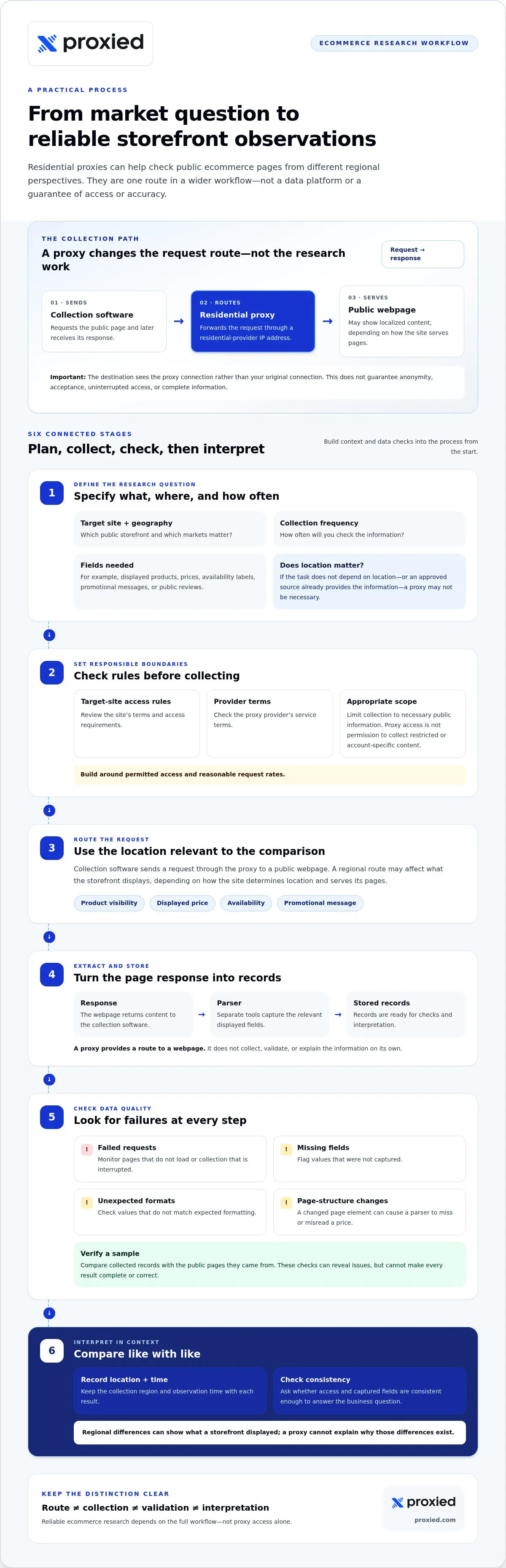
Residential proxies route a web request through an IP address associated with a residential internet provider. The destination site sees the proxy connection rather than your original connection. In a typical workflow, collection software sends the request, the proxy routes it, and separate tools extract, check, and interpret the response.
A residential proxy provides a route to a webpage, not an ecommerce data platform: it doesn’t collect, validate, or explain the information you find. This basic overview of how a proxy server works can help clarify the distinction. A proxy is one component of a wider research setup. It doesn’t guarantee that a page will load or that the information returned will be complete.
Which ecommerce questions can proxy-supported research answer?
Start with the research question to decide whether residential proxies for ecommerce are relevant. For competitor and assortment research, teams might compare publicly displayed products and prices across selected markets. Regional checks can also show whether a product page, price, or promotional message differs by location. Displayed availability labels, such as in stock or out of stock, can help track what a public storefront shows at the time of a check. Public product reviews may provide another source of customer feedback.
Keep the scope clear. Public product information is different from personal information, account-specific content, or pages available only after signing in. Proxy access is not permission to collect restricted information. Define the fields you need and limit collection to information that is publicly available and appropriate for your research purpose.
When are residential proxies worth evaluating?
Begin with four practical questions: Which site do you need to check? Which geographies matter? How often will you collect information? Which fields do you need? Residential access may be worth evaluating when your research depends on comparing what a public storefront displays from different regional perspectives. If the task doesn’t depend on location, or the same information is available through an approved source, a proxy may not be necessary.
Test the actual research workflow before scaling it. Check whether you can access the relevant pages and fields consistently, and whether the results answer your business question. Different locations may show different product visibility, prices, or availability, but a proxy can’t explain why those differences exist. Interpret findings in context, and record when and where each observation was collected.
Review the target site’s access rules and the provider’s service terms before collecting data. Build your process around permitted access and reasonable requests. A proxy can change the route of a request, but it doesn’t remove the need to use that route responsibly.
How Residential Proxies Work in an Ecommerce Data Workflow
A residential proxy is one part of a collection workflow, not the tool that does the research. Collection software sends a request through a proxy, the proxy forwards it to a public webpage, and the response returns to the software. Separate components then extract relevant fields, store records, and check data quality.
A proxy changes the apparent route of a request, not the research question or the work needed to turn a webpage into reliable data. For example, collection software might request a product page, a parser might capture its displayed price and availability text, and a quality check might flag missing or unexpectedly formatted fields. Each step can fail on its own, so proxy access alone doesn’t show that collection succeeded.
What changes when a request uses a residential proxy?
The destination site receives the request through the proxy’s IP address rather than directly through your own connection. This changes the request route, but doesn’t guarantee anonymity, acceptance, or uninterrupted access. If a request is routed through a particular region, the site may display localized content, depending on how it determines location and serves pages.
A location signal can affect the products, prices, or availability a storefront displays, so record the location and time alongside each observation. This context helps analysts compare like with like instead of treating regional page differences as changes to a product itself. It also supports a wider ecommerce digital strategy, where research should inform a defined business decision.
What residential proxies cannot guarantee
A proxy can’t guarantee that a webpage will load, that collection will continue without interruption, or that captured records will be accurate. Websites may apply access controls or rate limits, and page layouts can change. If a product price moves to a different page element, for example, a parser may miss it or capture the wrong value even when the request succeeds.
Build checks into the workflow. Monitor failed requests, missing fields, and unexpected changes in page structure. Review a sample of collected records against the public pages they came from, and note the collection time and target region. These checks can reveal issues, but they don’t make every result complete or correct.
Before collecting, check the target site’s access rules, the proxy provider’s terms, and applicable privacy requirements. Collect only information appropriate to your stated purpose. If residential access fits your defined workflow, you can review Proxied’s residential proxy offering as one option, while verifying its current terms and technical details before use.
Residential vs. Datacenter Proxies for Ecommerce Research
Choose a proxy type based on the data task, not a general claim that one category is better. Residential proxies use connections associated with residential internet providers, while datacenter proxies route requests through data center infrastructure. For ecommerce research, ask whether your target pages depend on location signals and how the site responds to each route.
- Connection type — Residential proxies: IP addresses associated with residential internet providers; Datacenter proxies: IP addresses associated with data center infrastructure; What to verify: How the provider describes and sources each connection type
- Likely use — Residential proxies: Research where regional storefront views may matter; Datacenter proxies: Collection tasks where residential location signals aren’t central; What to verify: Whether the target pages vary by region and which locations are available
- Trade-offs — Residential proxies: May be relevant for location-sensitive checks, but don’t guarantee localized results or access; Datacenter proxies: May suit less location-sensitive workflows, but may not provide the regional perspective required; What to verify: How each option performs on representative pages under permitted usage
- Operational fit — Residential proxies: Depends on available targeting and session controls; Datacenter proxies: Depends on available access controls and the collection setup; What to verify: Authentication, usage measurement, applicable limits, and documentation
Which proxy type fits price and product monitoring?
For price and product monitoring, first decide whether you need to observe regional storefront differences or gather information that is largely independent of location. If your research compares what shoppers may see in different markets, residential proxies for ecommerce are worth evaluating, provided the provider supports the locations and controls your workflow requires. If location isn’t important, a datacenter route may be a suitable alternative to test.
Don’t choose based on assumptions. Test a small set of representative pages and compare the fields you need, such as displayed price, product listing, or availability text. Record the location and collection time, then review missing or inconsistent results before expanding the workflow.
How should teams compare proxy providers?
Compare providers against operational requirements, not just advertised network scale. Check the locations you need, session options, authentication methods, documentation, and support availability. Ask how usage is measured, what limits apply, and what happens when a request fails. Verify each capability in current provider documentation before purchase, since details can vary between services and plans.
Proxied lists both residential and datacenter proxies, so teams can assess either category against the same research requirements. Confirm current service terms and technical details before deciding. Neither proxy type guarantees successful collection or accurate data.
How to Plan a Responsible Ecommerce Proxy Workflow
A reliable workflow starts with a defined research purpose, not a large collection target. Before using residential proxies for ecommerce, decide what business question the data should answer, which public pages can help, and how you’ll check the results. Record the purpose and the fields you plan to collect.
- Define the purpose. State the decision the research will support, such as comparing publicly displayed product availability across selected markets.
- Confirm access. Review the target site’s terms and access rules, applicable privacy requirements, and the proxy provider’s acceptable-use policies.
- Select fields. Collect only the public information needed for the stated purpose. Avoid personal information and account-restricted content.
- Test a small sample. Choose representative product pages and regions before expanding collection. Check that requests return the pages and fields you expect.
- Monitor the process. Track request outcomes, missing fields, duplicate records, location accuracy, and changes to page structure.
- Review and adjust. Compare a sample of stored records with the source pages. Pause collection if access rules or page behavior changes, then reassess before resuming.
How should a team pilot ecommerce data collection?
Keep the pilot focused: select a limited set of products, page types, and target regions that represent the full research task. Log successful and failed requests, whether required fields are complete, and any layout changes that affect extraction. Use conservative request patterns and adjust only within the target site’s rules and provider terms. A small pilot can reveal workflow gaps before they affect a larger dataset.
Before scaling, confirm the purpose, permitted access, required fields, regional accuracy, and data-quality checks. Treat this as a go or no-go checklist, not a one-time setup. Repeat the review when targets, page structures, or collection needs change.
How can teams protect data quality and responsible access?
Minimize collection. If the analysis needs product title, displayed price, and stock signal, don’t gather unrelated fields. Check for duplicate entries and missing values, and retain the page location and collection time so teams can interpret regional observations consistently. Quality checks can flag suspicious records, but can’t guarantee that every captured value is correct.
Assign someone to review access conditions and pause the process if a site changes its rules or pages in ways that affect collection. Proxy access is only one part of the workflow; it doesn’t replace responsible use or validation. If you’re evaluating a provider for this process, review Proxied’s residential proxies and verify current capabilities and terms against your requirements.
Choosing a Residential Proxy Provider for Ecommerce
Choose a provider based on your actual research workflow, not its headline network claims. For residential proxies for ecommerce, the key question is whether the service’s locations, controls, and terms fit the pages and public data you need to check. A large network alone doesn’t confirm that the locations you need are available or that the target site will return useful results.
What should ecommerce teams verify before choosing?
Use this practical checklist before comparing plans or making a purchase:
- Target coverage: Confirm that the provider supports the locations relevant to your research. Ask how location targeting works and verify it against the regions you plan to test.
- Access and controls: Check authentication methods, session behavior, usage limits, and any controls your collection software requires.
- Integration: Confirm the connection details and technical requirements needed to route requests through your existing setup.
- Terms and policies: Review acceptable-use rules, how usage is measured, and how the provider communicates policy or service changes.
- Support and documentation: Check what setup guidance is available, how support can be contacted, and whether technical documentation answers your implementation questions.
Verify each detail in current provider documentation rather than relying on a sales summary. Then test representative product pages and regions. Track whether requests return the expected page, whether the required fields are present, and whether results serve your research purpose. This gives you a task-specific basis for comparison without assuming that advertised scale translates into workflow fit.
When should you evaluate Proxied residential proxies?
Consider Proxied if residential proxy access fits a defined ecommerce research task. Proxied also lists datacenter proxies, so you can compare those routes with residential access using the same test pages, regions, fields, and acceptance criteria. Focus on your requirements rather than declaring one proxy type universally superior.
Before deciding, confirm Proxied’s current location availability, session options, authentication, integration details, usage limits, and service terms. Don’t assume these capabilities or any particular performance; check current product documentation and test results for your own workflow. Proxy access is one component of collection, not a guarantee of access or data quality.
Once you’ve defined your workload and verification criteria, explore Proxied proxy options and compare the available details with your requirements.
Make Your Ecommerce Proxy Choice Fit the Research
Residential proxies for ecommerce can support regional product and price research when storefront differences matter. But the proxy is only one part of the workflow: useful findings also depend on choosing relevant public data, validating collected records, and respecting site and provider terms.
Start with the task. Identify the pages, locations, and fields your team needs, then test a representative sample before scaling. Compare residential and datacenter routes against the same requirements rather than assuming one category will suit every job. Check provider locations, controls, usage limits, documentation, and current service terms before committing.
Proxied lists residential proxies and datacenter proxies, giving teams two connection types to evaluate against a defined workflow. For workflows that need mobile-network connectivity, Proxied also offers Dedicated 4G and 5G Mobile Proxies. Confirm current product details and suitability for your requirements before deciding. Explore Proxied proxy options and use your research criteria to guide the comparison.
A clear purpose and careful pilot make the next step easier. Build your process around measured results, responsible access, and the data your team actually needs.
Frequently Asked Questions
What are residential proxies for ecommerce?
Residential proxies for ecommerce route requests through IP addresses associated with residential internet providers. This can help a research team check how public product pages appear from selected locations if the site serves different content by region. A proxy only changes the request route. It doesn’t find product pages, extract prices, validate stock information, or interpret results. Those tasks require collection software and a process for checking and managing the data.
How do ecommerce teams use residential proxies?
Ecommerce teams may use residential proxy connections to research public product listings, displayed prices, availability signals, or reviews. For example, a team could compare selected public product pages across regions to see whether the displayed information differs. Collection software sends requests, while separate tools or steps extract and review the results. Teams should define the business purpose, limit collection to necessary public information, and follow site and provider terms.
Are residential proxies better than datacenter proxies for ecommerce?
Neither type is universally better; the right fit depends on the research task and target site. Residential proxies use connections associated with residential internet providers, while datacenter proxies route through data center infrastructure. If regional storefront views matter, test whether residential access supports the locations and observations required. For tasks less dependent on location, datacenter proxies may be worth evaluating. Compare both using representative pages and the same data-quality criteria.
Can residential proxies prevent ecommerce websites from blocking requests?
No. A residential proxy can’t guarantee that a website will accept requests, prevent blocks, or allow uninterrupted collection. Sites may use access controls or rate limits, and their behavior can change. Follow applicable site rules and provider terms, and use reasonable request patterns. Monitor request outcomes and pause collection if access conditions change. A proxy is one part of a data workflow, not a way to bypass restrictions or ensure successful scraping.
How do I choose a residential proxy provider for ecommerce?
Start by defining the target sites, regions, collection frequency, and required data fields. Then verify the provider’s location availability, authentication, session options, usage limits, integration requirements, documentation, support availability, and acceptable-use terms. Test representative pages instead of relying on network-size claims. Check whether the returned pages and fields meet your needs, and confirm current service details before purchase. The provider should fit the workflow you’ve defined, not determine the research scope.
Are residential proxies legal to use for ecommerce data collection?
Legality depends on factors such as where you operate, how proxy IP addresses are sourced, what information you collect, and how you use it. Check applicable laws, the target website’s terms, and the provider’s sourcing and acceptable-use policies before collecting data. Public availability alone doesn’t settle every question, especially if information relates to individuals or requires account access. For a specific use case, seek appropriate legal guidance rather than assuming proxy use makes collection permissible.
Do residential proxies collect product prices and stock data automatically?
No. A residential proxy routes a request; it doesn’t locate products, extract price or stock fields, or store records. Collection software must request the relevant public pages, and separate parsing and quality checks may be needed to capture and review the information. Pages can change, and displayed availability may not represent a confirmed inventory count. Check records for missing or duplicate fields and compare samples with the source pages before using them in analysis.