



See proxies
See proxies
Purchase
Select Country
Listings will appear after a country has been selected.
Residential Proxies for SEO: Guide to Accurate Research

Hannah

More IP rotation doesn’t automatically mean better SEO data. Residential proxies for SEO can help you observe search results from different locations, but useful findings depend on controlling the sample, including location, language, device, and timing.
If you’ve compared results manually, you’ve likely seen how quickly they vary and how difficult repeated checks are to scale. A proxy can provide another local vantage point, not a definitive picture of rankings. You still need a consistent method and checks for data quality, search engine policies, and website terms. This guide explains where residential proxies fit into SEO research, how to compare proxy approaches with your location and scale needs, and how to build a repeatable workflow. You’ll also learn what to consider when interpreting location-specific observations so your research is more representative and easier to act on.
Key Takeaways
- Match proxy type to the research task: residential, datacenter, and mobile proxies provide different network contexts.
- Use residential proxies for SEO as one part of a structured data-collection workflow, not as a shortcut to guaranteed rankings or complete results.
- Control location, language, device context, and timing to make search observations more useful and comparable.
- Before collecting data, review relevant search engine policies, website terms, robots.txt, and privacy requirements.
- Test a small, representative research task first, then assess data quality and workflow fit before scaling up.
SEO Residential Proxies in Location-Based Research
Search results aren’t a fixed snapshot. The same query can show different pages depending on a searcher’s location, language settings, device, and search time. A residential proxy routes a request through an intermediary IP associated with a residential network, giving an SEO researcher another vantage point for location-aware observations. It doesn’t guarantee that those observations match every local user’s experience.
A residential proxy routes selected internet traffic through an IP associated with a residential network; a datacenter proxy uses an IP from server-hosting infrastructure, while a VPN typically routes a broader device connection through an encrypted tunnel. These terms describe different routing approaches, not a promise of anonymity or access. For a technical overview of how a proxy server forwards requests, see Wikipedia’s explanation.
Which SEO tasks can benefit from residential proxies?
Residential proxies for SEO can support targeted observations when a team needs to see how a search results page or website appears from selected markets. For example, an analyst might compare the pages appearing for a local service query in two cities, review competitor titles and snippets, or check whether localized landing-page content is visible as intended.
Use the proxy to support data collection, then interpret the findings separately. It doesn’t replace a ranking measurement method, keyword tracking system, or SEO strategy. Treat each observation as a sample: record the query, intended location, language, device context, and time so comparisons have useful context.
What residential proxies do not solve
A proxy won’t improve a site’s rankings or replace technical SEO work such as resolving crawl issues, improving page performance, or refining content. Nor does it guarantee accurate results or access to every page. Search engines may vary results for reasons beyond apparent location, including personalization, query interpretation, current index changes, and the conditions of the request.
Keep the technical roles distinct. A proxy changes the network route and the IP address a destination sees. It doesn’t render a page in a particular browser, track keywords, or provide analytics by itself. Browser settings affect how pages are displayed; tracking tools organize ranking observations; analytics platforms report activity measured on a site. Combining these tools may support a broader workflow, but each answers a different question.
Use residential proxies as one component of location-based research, not as a complete SEO measurement system. That distinction helps teams make careful comparisons and avoid treating a single search snapshot as a definitive ranking report.
How Residential Proxies Shape SEO Data Collection
A useful local search observation starts with a research question, not a proxy setting. Are you checking whether a service page appears for a city-specific query, comparing competitor visibility across markets, or reviewing how localized content is displayed? Define the question first, then select the queries and locations that can help answer it.
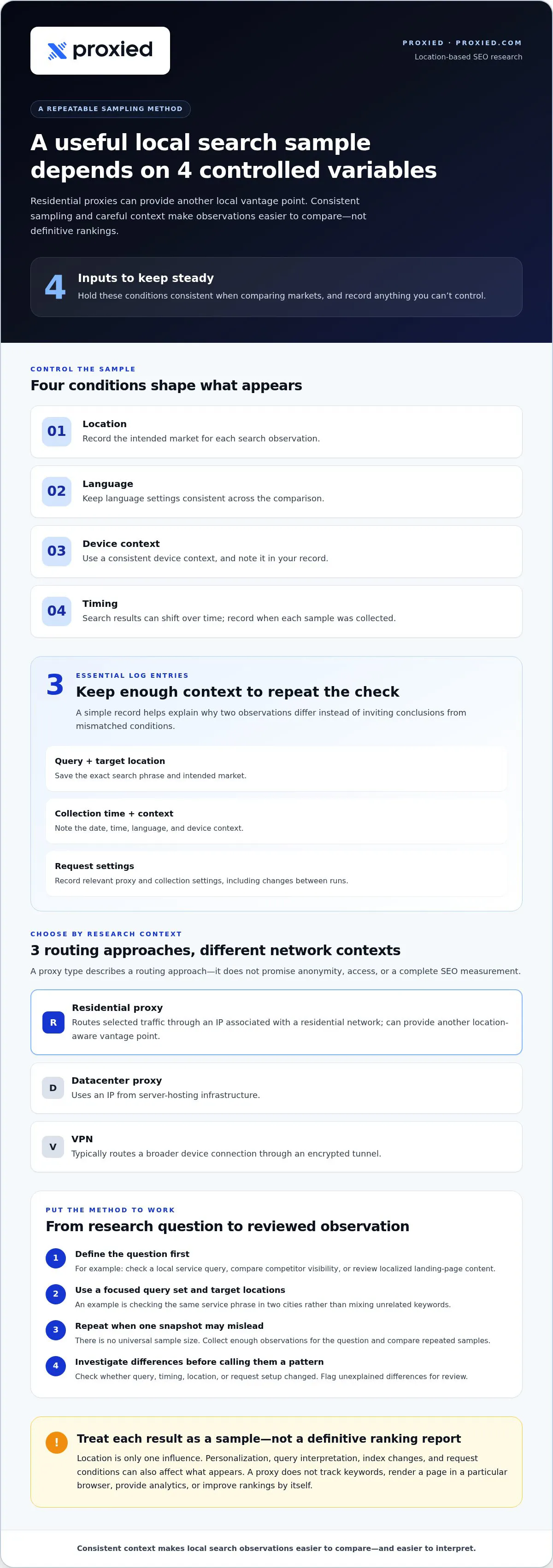
Consistent sampling makes search observations easier to compare, but it can’t guarantee identical results. Search pages may shift over time, and location is only one influence. Language, device context, query wording, and changes to the search environment can all affect what appears. Keep these variables steady when comparing markets, and note any that you can’t control.
Build a controlled local SERP sample
Choose a focused set of queries and target locations tied to the same SEO objective. For a local service business, that might mean checking the same service phrase in several target markets rather than mixing unrelated keywords. Keep language, device context, and collection timing consistent across observations. If you change the setup, record the change so it isn’t mistaken for a market difference.
There’s no universal sample size. Collect enough observations to suit the question, and repeat them when a single snapshot could be misleading. A useful record includes:
- Query and target location: Save the exact search phrase and intended market.
- Collection time and context: Note the date, time, language, and device context.
- Request settings: Record relevant proxy and collection settings, along with any changes between runs.
This basic log makes the work repeatable. It also helps explain why two samples differ, rather than encouraging conclusions from results collected under different conditions.
Validate proxy-collected findings
Compare repeated samples before treating a result as a pattern. If a page appears in one observation but not another, check whether the query, timing, location, or request setup changed. Flag unexplained differences for review. Don’t assume that one SERP snapshot represents every searcher in that market.
Use other data sources to add context, not to force an exact match. Google Search Console can provide first-party performance data for a verified site, while analytics and third-party SEO tools answer different questions and may use different methods. If their reports differ from proxy-collected observations, document the discrepancy and investigate the measurement context.
Residential proxies can support location-aware collection as one part of a broader workflow. Proxied offers residential proxy options for web scraping and data collection.
Residential vs. Datacenter Proxies for SEO: Choose by Task
Choose a proxy type based on what you need to observe, where the research takes place, and how collection will run. Residential proxies for SEO may suit location-aware observations where routing through a residential IP is relevant to the research design. Datacenter proxies may fit infrastructure-based collection, while mobile proxies are useful when the mobile network context itself is part of the question.
None of these categories guarantees accurate results or successful access. Accuracy depends on the query, collection setup, timing, and validation process, as well as the proxy route. Set responsible request volumes and follow applicable policies and website terms.
- Compare local search appearances across target markets — Relevant proxy type: Residential; Key trade-off: Residential routing can support location-aware sampling, but doesn’t ensure a particular SERP or access outcome. Validation method: Repeat samples with the same query, language, device context, and timing.
- Collect data where infrastructure-based routing meets the task — Relevant proxy type: Datacenter; Key trade-off: It may fit infrastructure-focused workflows, but may not represent the residential network context the question requires. Validation method: Compare results with a small sample using the intended research context.
- Investigate search or site behavior on mobile networks — Relevant proxy type: Mobile; Key trade-off: It adds a mobile network context, but doesn’t replace device, browser, or query controls. Validation method: Keep device and query settings consistent, then compare repeated observations.
When residential proxies may fit SEO research
Consider residential routing when the research question depends on observing search appearances from selected local markets. A team comparing how the same category query appears in different regions can use residential proxies as part of its collection setup. Match locations to the markets that matter, collect only the data needed, and compare observations rather than assuming each result represents every searcher there.
For distributed collection, plan request volume around the research objective and applicable site requirements. More requests don’t automatically produce better evidence.
When another proxy type may be sufficient
Datacenter proxies can be a practical option when the task prioritizes infrastructure-based collection and doesn’t depend on residential network context. Choose mobile proxies when the question specifically concerns mobile network behavior. In either case, test a representative sample and document the setup. The right choice is the one that fits the target markets, data needs, and responsible collection limits, not a universal ranking of proxy types.
How to Use Residential Proxies for SEO Responsibly
Begin with the research question. Use the least complex collection method that can answer it, and limit requests to the information needed for that purpose. A focused check of localized search results may require a different approach from ongoing collection across multiple markets. Residential proxies for SEO can support location-aware research, but they should not be used to evade restrictions, impersonate specific people, or claim guaranteed access.
Before collecting data, review relevant search engine policies, the target website’s terms, its robots.txt instructions, and applicable privacy requirements. These sources may set different expectations, so assess them for the specific sites and data involved. If a task would require ignoring access restrictions or collecting information outside your permitted purpose, stop and reconsider the method.
Set clear collection boundaries
Define which queries, locations, and pages are relevant, then keep collection within that scope. Use conservative request patterns suited to the task. Monitor responses and errors; if you see access signals that indicate a problem, pause collection rather than trying to work around the restriction.
Keep only the results needed for the research. Set clear retention periods and limit access to people who need the data. Document how findings are stored and who can use them. These steps help reduce unnecessary collection and make the workflow easier to review later.
Keep findings useful and auditable
For each collection, record the date and time, query, intended location, relevant request settings, and any known limitations. If the language, device context, or setup changes, note it. Without that context, a difference in results may be difficult to interpret or reproduce.
Separate what you observed from what you conclude. A search result seen at one point is an observation, not proof of a lasting ranking position. Compare repeated samples and use appropriate first-party or third-party data to add context. If the sources disagree, flag the difference for review instead of assuming one report is definitive.
Review policies and access instructions, collect controlled samples, and document findings with their limits. This checklist supports responsible collection and helps others understand how the observations were gathered.
Proxied residential proxies support location-aware web data collection as one component of a workflow built around clear boundaries and documented research needs. See Proxied residential proxies.
Evaluate Residential Proxies for SEO and Build a Scalable Workflow
Evaluate residential proxies against the research task, not headline claims about network size. The key question is whether the proxy approach can support your target markets and fit the way your team collects, reviews, and reports search data. A small, representative trial can reveal data-quality issues and operational friction before you increase collection volume.
Create a practical evaluation checklist
Start with the markets in your SEO plan. Compare those geographic needs with the locations available for the research, then examine connection behavior and the practical details of using the service. Check whether the setup fits your existing tools and whether you can see enough usage information to monitor the trial.
- Geographic relevance: Does the available location context align with the markets you need to study?
- Workflow fit: Can your team incorporate the connection method into its collection process?
- Visibility and error handling: Can you monitor usage, spot failed requests, and review connection behavior?
- Operational effort: How much time does setup, troubleshooting, and validating the collected data take?
Test a small set of representative queries and locations. Review consistency across repeated observations, note errors, and track analyst effort. This gives you a more useful basis for comparison than IP counts or marketing claims alone.
Move from a test to a repeatable SEO process
Before scaling, define who owns the workflow, which queries and locations it covers, how often samples are collected, and how findings will be reported. Keep proxy observations labeled as observations. They’re distinct from Google Search Console and other first-party metrics, which reflect different data sources and answer different questions.
Expand collection only when the test produces usable data and the process remains manageable. Document the settings and limitations so results can be reviewed consistently as the workflow grows. Reassess when target markets or research needs change.
Proxied offers residential proxies for web scraping and data collection, using real IP addresses. SEO teams can use Proxied residential proxies as one component of a broader process for gathering location-aware web data, guided by the research scope and collection approach.
Build a More Reliable Local SEO Research Workflow
Useful location-based SEO research depends on more than the IP address behind a request. Define the question, control the variables you can, and record the query, location, timing, and collection settings. Then compare repeated observations and treat them as samples, not definitive rankings.
Choose residential, datacenter, or mobile proxies according to the research context. A proxy can support data collection, but it won’t improve rankings, guarantee accurate results, or replace technical SEO and first-party measurement. Keep your workflow focused, review relevant policies and website terms, and test a small sample before scaling.
Proxied offers residential proxies for web scraping and data collection, with proxy services available globally. If location-aware research is part of your SEO workflow, explore Proxied residential proxies for your data workflow.
Start with a clear question and a controlled test. Each well-documented observation can help your team make informed decisions and build a research process with confidence.
Frequently Asked Questions
Are residential proxies useful for SEO?
Yes, residential proxies can support SEO research that depends on observing web content from different locations. They may help teams collect localized search results, review competitor appearances, or check market-specific content. They don’t improve rankings or guarantee that collected results are complete or representative. Treat each observation as a sample, record the query and collection context, and validate findings against other relevant data before making decisions.
How do residential proxies help with local SERP analysis?
They route selected requests through residential IP addresses, which can provide another network location for collecting search result observations. An SEO team might compare the same query across selected markets, keeping language, device context, and timing as consistent as possible. Results can still vary for reasons beyond location. Record the setup and repeat samples rather than treating one search page as a definitive view of local rankings.
Are residential proxies better than datacenter proxies for SEO?
Not universally. Residential proxies may fit research where residential network context or location-aware observations matter. Datacenter proxies may suit tasks that prioritize infrastructure-based collection and don’t require that context. Neither type guarantees accurate data or successful access. Choose according to the research objective, target markets, request pattern, and applicable site requirements, then test a representative sample to see whether the results and operational effort fit the task.
Can I use residential proxies to track Google rankings?
You can use them to collect search result observations from selected locations, but a proxy alone isn’t a rank-tracking system. Rankings can vary with query, location, language, device context, and time, and a single result page may not represent a stable position. For useful comparisons, standardize the collection setup and repeat samples. Consider Google Search Console for first-party performance data about your verified site.
Do residential proxies guarantee access to search results or websites?
No. A residential IP doesn’t guarantee that a search engine or website will return a page, provide complete results, or accept a request. Access can depend on the destination’s policies, request behavior, and other conditions. Don’t treat proxies as a way to bypass restrictions. Review relevant terms and access instructions, monitor errors, and pause collection if responses indicate a problem.
How should an SEO team choose residential proxies?
Start with the research question and the locations your SEO plan needs to cover. Assess geographic relevance, connection behavior, integration fit, usage visibility, and how much effort the workflow takes to operate. Run a small test with representative queries before increasing volume. Compare repeated observations, review errors, and document settings and limitations. Judge the approach by data quality and workflow fit, not IP counts alone.
Are residential proxies legal for SEO research?
Legality depends on where and how you use them, the data you collect, and the websites involved. Research involving public information may be treated differently from activity that violates site terms, bypasses security measures, or collects sensitive or personal data. Review applicable laws and privacy requirements, search engine policies, website terms, and robots.txt instructions before collecting data. When requirements are unclear, seek qualified legal guidance.